SiP/Chiplet Chip Reliability and Failure Analysis
Reliability testing is typically used to verify whether packaged devices or modules can operate reliably during subsequent service. The device-level reliability testing items provided are as follows:
For product failures occurring after reliability testing or during later service, failure analysis methods are needed to identify root causes and improve processes. Failure analysis should follow the principle of non-destructive analysis first, followed by destructive analysis, to trace the cause of failure as comprehensively as possible. The relevant failure analysis equipment and capabilities currently available at this public service platform are as follows:
| Reliability Test | Reference Standard | Test Purpose |
|---|---|---|
| Preconditioning | JESD22-A113 | Simulates environmental stresses (temperature, humidity) during transport, storage, and reflow soldering. Conducted prior to reliability tests; represents package level only. |
| MSL | IPC/JEDEC J-STD-020 | Classifies moisture-sensitive non-hermetic solid-state SMDs for proper packaging, storage, and handling to prevent reflow/service damage. |
| THT | JESD22-A101 | Evaluates reliability of non-hermetic packages under long-term humidity and temperature stress. |
| HTST | JESD22-A103 | Determines effects of temperature and time under storage conditions; identifies thermally activated failure mechanisms and time-to-failure distributions.
|
| LTST | JESD22-A119 | Same purpose as HTST (see above). |
| TCT | JESD22-A104 | Determines the ability of devices or solder interconnects to withstand mechanical stresses from alternating high/low temperature changes. |
| LAPT | IEC 60068-2-13:1983 | Determines device capability for storage, transport, or operation under low atmospheric pressure. |
| ESD | JESD22-A114 | Tests device damage or degradation under defined ESD conditions to classify ESD sensitivity. |
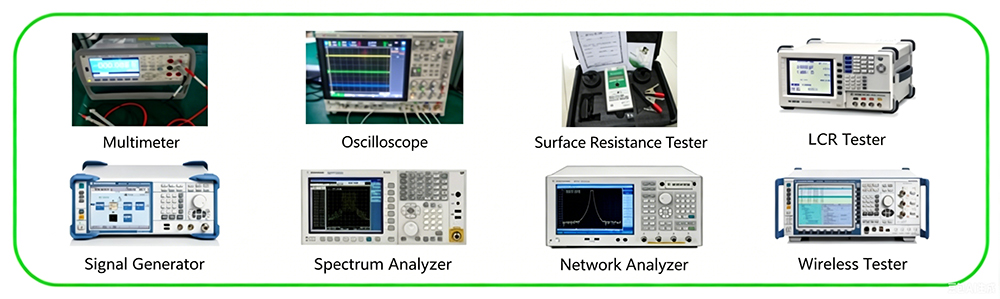
Electrical Performance Analysis Equipped with digital multimeters, oscilloscopes, signal generators, resistance testers, LCR meters, spectrum analyzers, network analyzers, wireless comprehensive testers, and other equipment, enabling preliminary fault localization;
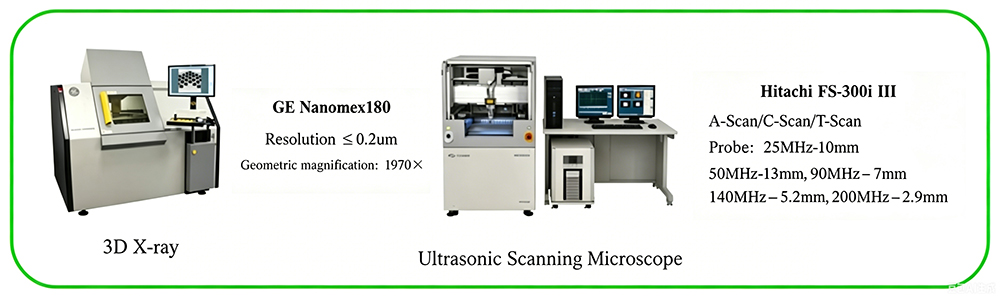
Internal Structure Analysis (Non-Destructive) Equipped with 3D X-ray and scanning acoustic microscopes, enabling observation of internal voids, broken wires, delamination, bubbles, cracks, and other failures without destroying the product structure;
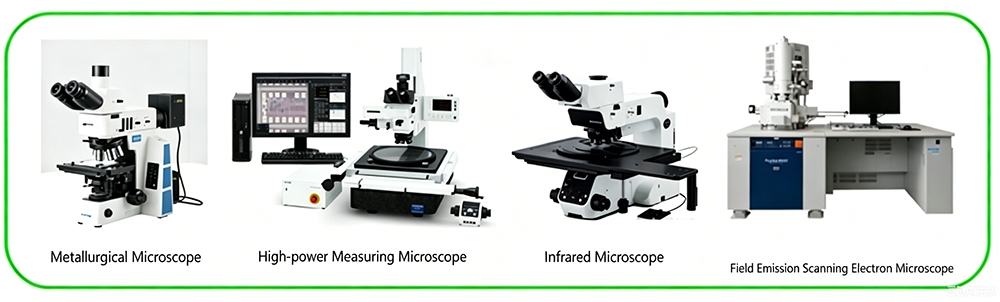
Microscopic Morphology Analysis Equipped with optical microscopes, infrared microscopes, scanning electron microscopes, and other equipment for defect or microscopic morphology observation, composition analysis, etc.