Going Viral Across the Web: 2026 AI Heterogeneous Computing Platforms—Understanding This AI "Mass Collaborative Mega-Project"
Many people are curious: with AI large models, short videos, intelligent customer service, and industrial quality inspection proliferating everywhere, what exactly handles the massive volume of computing tasks? The answer is—AI heterogeneous computing platforms.
In 2026, it has transformed from "niche technology" into the core infrastructure of the entire AI industry. Today, using plain language and fun analogies, we'll help you thoroughly understand this sector.
I. Understand in One Sentence: What Is an AI Heterogeneous Computing Platform?
Let's start with an analogy:
In a super-sized restaurant flooded with orders daily, if you make the head chef chop vegetables, cook, wash dishes, and take orders all by himself, he'll definitely collapse from exhaustion and food will come out painfully slowly.
The smart approach is division of labor:
• Head Chef (CPU): Overall management, complex decision-making, handling miscellaneous tasks
• Vegetable Chopper (GPU): Batch repetitive work, blazingly fast
• Specialist Kitchen Assistants (NPU/FPGA): Focused on specific types of specialized tasks, fast and efficient
An AI heterogeneous computing platform is precisely this super kitchen with clear division of labor and efficient collaboration.
It no longer relies on just one type of chip to do the work, but integrates multiple chips with different strengths—CPU, GPU, NPU, FPGA, etc.—assigning tasks based on expertise, doubling overall efficiency while dramatically cutting costs.
Quick summary:
Heterogeneous = multiple types of chips working in coordination; Computing Platform = a supercomputing center with unified scheduling and management.
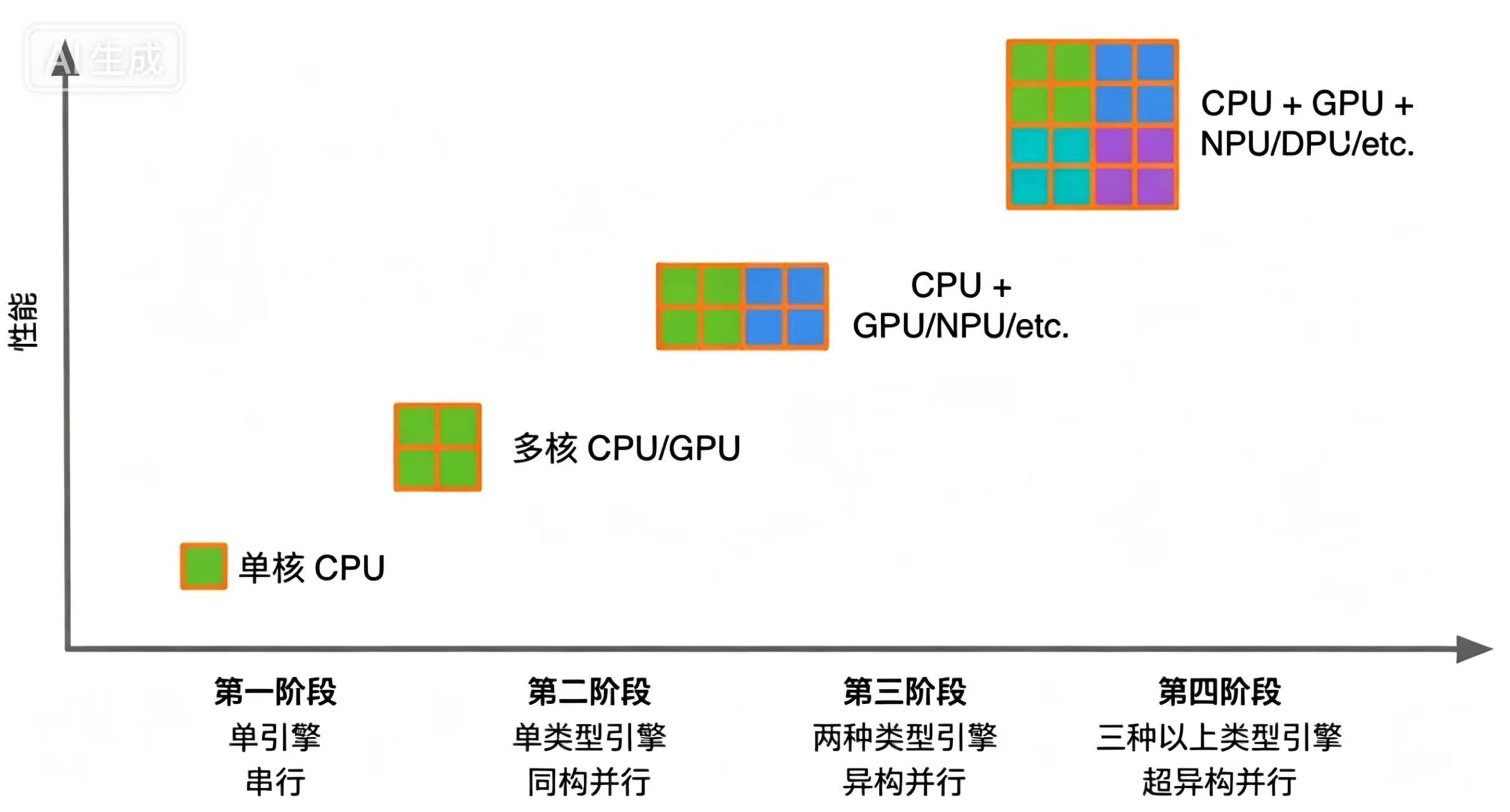
II. Why Did It Suddenly "Go Viral Across the Web" in 2026?
1. Exploding AI Computing Demand, a Single Chip Can't Handle It
Nowadays, large model parameters are growing ever larger, AI applications are everywhere, and global computing power doubles every three months.
Using only one type of chip results in either insufficient speed or absurdly high electricity and hardware costs. Heterogeneous fusion has become the industry's sole solution.
2. Full-Scale Rise of Domestic Chips, "A Hundred Flowers Blooming" Forces Heterogeneity
In the past, computing power basically relied on a single category of chips. Now, domestic NPUs and AI-specific chips are rapidly maturing, making mixed deployment of multiple chip types the norm.
Enterprises are no longer "hanging themselves on one tree," but are building heterogeneous platforms compatible with various chips—safe, cost-effective, and independently controllable.
3. Traditional Computing Utilization Is Too Low, Heterogeneity Is the Cure for "Resource Waste"
Data shows that resource utilization rates on traditional computing platforms are generally only 20%–30%, with large amounts of expensive chips "slacking off."
Heterogeneous platforms come with intelligent scheduling, precisely assigning tasks to idle chips, maxing out computing power utilization, saving money while boosting efficiency.
III. 2026 Industry Status: Scale, Landscape, Real-World Deployment
1. Market Size: Racing Ahead, Continuous Expansion Over the Next 5 Years
The domestic AI heterogeneous computing platform market was approximately RMB 33 billion in 2025, expected to exceed RMB 137.1 billion by 2030, with an average annual growth rate as high as 32.9%—a solid high-growth golden track.
2. Industry Chain Division of Labor: Each Plays Its Role, a Complete Closed Loop
• Upstream: Various AI Chips
CPUs, general-purpose GPUs, domestic NPUs, FPGAs, specialized accelerator chips form the "computing components."
• Midstream: Heterogeneous Computing Platforms (Core)
Responsible for unified management, intelligent scheduling, and interconnection—the "brain + dispatch center" of the entire system.
• Downstream: Applications Across Countless Industries
Large model training/inference, internet, finance, industry, transportation, healthcare, film rendering, etc.
3. Mainstream Deployment Scenarios in 2026 (Visible and Tangible)
• AI Large Models: Training and conversational inference entirely supported by heterogeneous clusters, ensuring fast response and strong concurrency
• Intelligent Manufacturing: Production line quality inspection, equipment fault prediction, millisecond-level defect identification
• Smart City/Transportation: Intersection monitoring, autonomous driving, traffic flow scheduling, multi-device collaborative computing
• Financial Risk Control: Real-time anti-fraud, risk interception, high concurrency, low latency
• Content Generation: AI painting, short videos, digital humans, batch rendering without lag
IV. Three Core Development Trends in 2026 (Plain Language Interpretation)
Trend 1: Cloud-Edge-Endpoint Integration, Computing Power "Everywhere"
In the past, computing power was concentrated in large data centers (cloud).
Starting in 2026, cloud + edge server rooms + terminal devices will be fully interconnected, enabling nearby computation and remote collaboration.
Simply put: smartphones, cameras, and industrial computers will also share the computing load, so not all data needs to travel to distant server rooms—faster speeds, stronger privacy protection.
Trend 2: Chiplet Proliferation, "Building Block" Assembly for High-End Chips
High-end chips are no longer built solely from a single complete wafer; instead, like assembling building blocks, small chips (chiplets) with different functions are combined together.
Paired with heterogeneous platforms, this achieves high performance, low cost, and rapid iteration, becoming a key technology for breakthroughs in domestic computing power.
Trend 3: Computing Power Services Become "Foolproof," Available On-Demand Like Electricity
In the future, enterprises won't need to buy a pile of chips and build their own server rooms.
Heterogeneous computing platforms will become public computing power services, like utility grids—invoked on demand and billed by usage.
Even companies with no technical expertise can easily access top-tier AI computing power, with barriers to entry drastically lowered.
V. What Ordinary People Care About: How Does This Relate to Us?
Many think "computing power" is far removed from daily life, but that's not true:
• Browsing short videos, AI chat, digital human live streaming—all backed by heterogeneous computing power;
• Express sorting, factory automation, smart traffic at intersections—speed up operations and reduce risks thanks to it;
• AI photography on phones, real-time translation, smart navigation are also gradually connecting to edge heterogeneous computing power.
The stronger the heterogeneous computing power, the smoother, cheaper, and smarter the AI services we use will become.
VI. Summary: In 2026, Heterogeneous Computing Power Enters the "Era of Universal Adoption"
Viewed from its technical essence: it is efficient division of labor among multiple chips;
Viewed from its industry positioning: it is the new computing power foundation of the AI era;
Viewed from its development stage: 2026 has moved past the conceptual phase and entered a golden period of large-scale deployment, domestic substitution, and ecosystem maturation.
In the coming years, all AI applications and digital industries will be built upon heterogeneous computing platforms. Understanding it means understanding the underlying logic of artificial intelligence and the digital economy for the next several years.
Shanghai Liyuan Micro Semiconductor Co., Ltd. is a professional SiP system-in-package solution development platform. For many years, we have provided customers with one-stop services and solutions, including ASIC chip design, SiP packaging design and simulation, SiP internal wafer procurement,
packaging production, system-level testing, reliability and failure analysis, and more. Our company offers free SiP/Chiplet design consultation and services to all customers,
dedicated to helping clients achieve design goals such as small form factor, low power consumption, and low cost. If interested, please feel free to contact us at +86 13817180836 (same number for WeChat).