From Catching Up and Counterattacking to Blooming Everywhere: Domestic Computing Power Graphics Cards Are Rewriting the Industry Landscape | 2026 China GPU Chip Industry In-Depth Analysis
Opening: Understand What a GPU Is in One Sentence
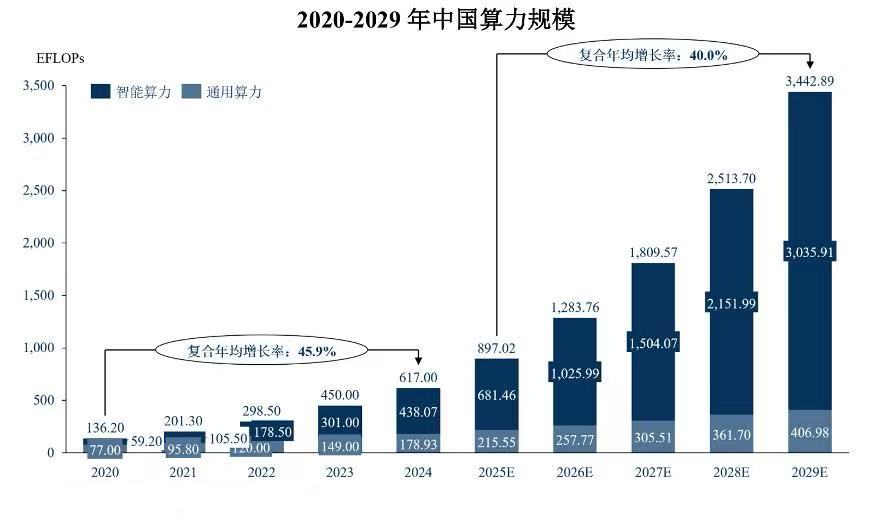
If the CPU is likened to a meticulous white-collar clerk, precisely handling one small task at a time, then the GPU is a team of hundreds or thousands of assembly line workers collaborating. AI image generation, large model chat, AAA games, and smart city simulations all rely on its relentless computing power output—it is the "electricity and coal" of the current artificial intelligence era. A few years ago, domestic high-end GPUs were almost entirely imported. In 2026, domestically produced GPUs have officially transformed from laboratory samples into essential hardware procured in large volumes by government enterprises and major internet companies, marking a historic inflection point for the industry.
I. 2026 Market Overview: A Hundred-Billion Track Racing Ahead, Domestic Penetration Rate Soars by Leaps and Bounds
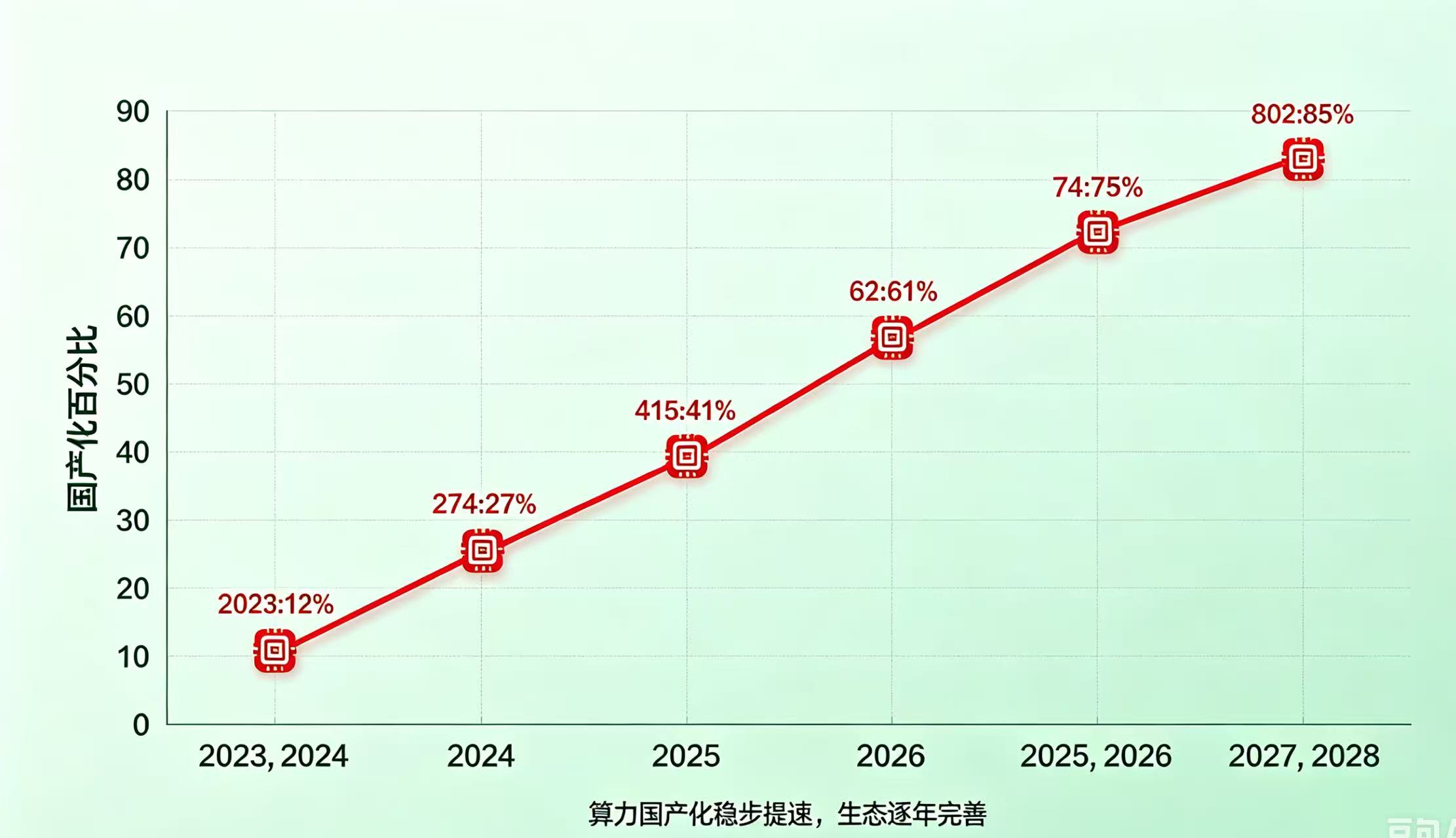
In 2026, the overall domestic GPU market surpassed RMB 180 billion, with annual shipments of domestic AI accelerator cards estimated at 2.15–2.4 million units, and the domestic substitution rate breaking through the 60% mark. NVIDIA, which once monopolized over 80% of the domestic high-end computing power market, saw its market share in China shrink to single digits.
Policy + demand twin engines are maxed out: The National Development and Reform Commission explicitly requires major domestic AI large models to mandatorily adapt to domestic GPUs, and nine domestic chips have obtained national security certification. For information self-reliance and controllability, government affairs, finance, telecommunications, and intelligent computing centers are replacing overseas graphics cards in large volumes. Leading domestic manufacturers generally saw Q1 revenue surge by 75%–160%.
Simple examples: Moore Threads achieved single-quarter revenue of RMB 738 million, a year-on-year surge of 155%, securing a major order for a 66,000-card intelligent computing cluster. Cambricon's single-quarter revenue exceeded RMB 2 billion, with net profit soaring 185% year-on-year, completely breaking free from years of chronic losses.
II. The Four Major Factions of Domestic GPUs, Each Performing Its Role, A Hundred Flowers Blooming
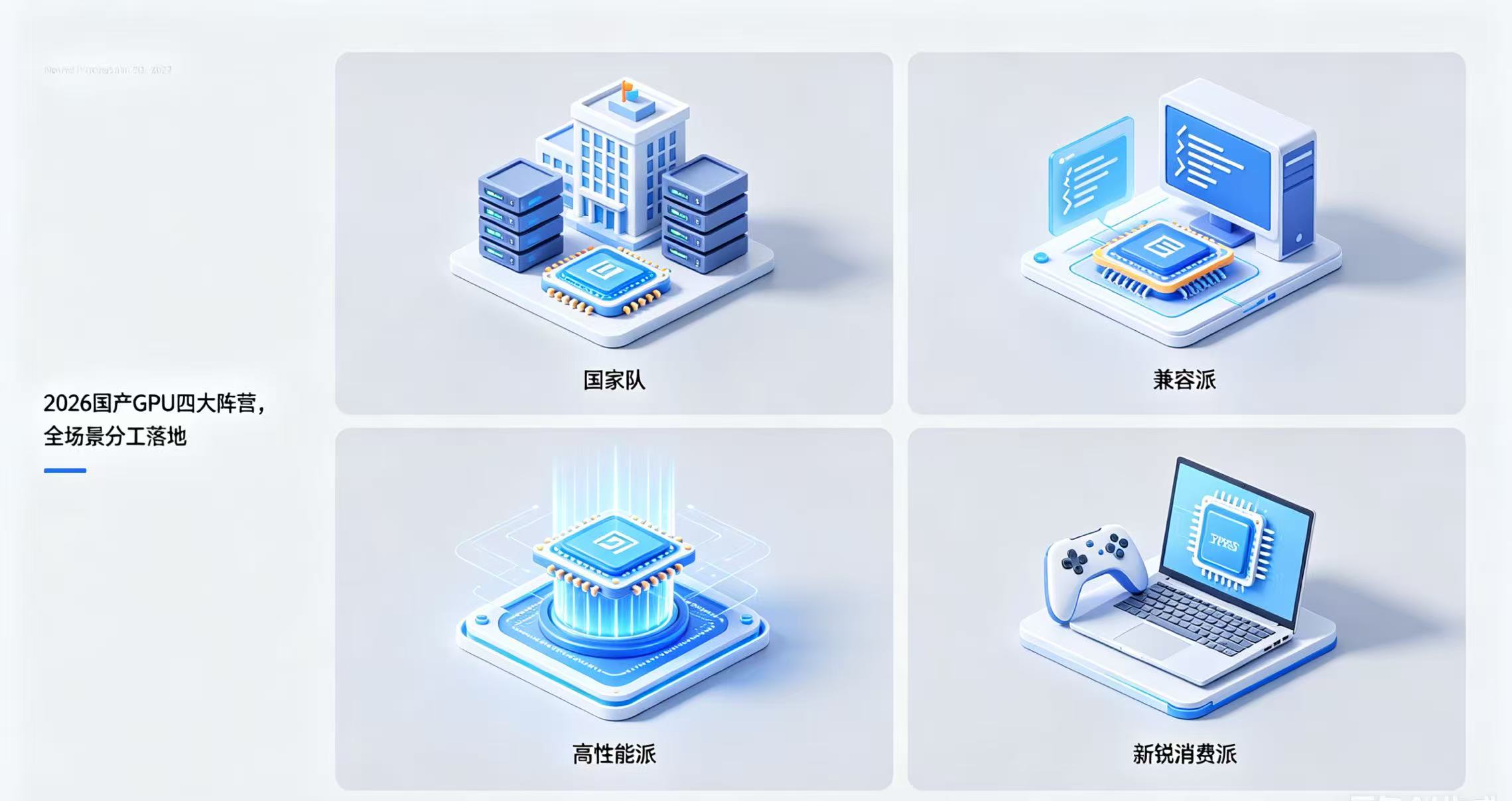
Domestic players have differentiated into four major camps, competing with overseas giants through staggered positioning. Insiders jokingly call them the "Four Great Troupes" of domestic GPUs:
1. National Team (Huawei Ascend, Jingjia Micro): The Steady Infrastructure Faction
Huawei Ascend is the industry leader, accounting for over 44% of domestic computing power card shipments. Its self-developed Da Vinci architecture 910B chip approaches 80% of the computing power of NVIDIA's A100, making it the top choice for government and telecom operator intelligent computing centers. Jingjia Micro, with its military-industrial background, deeply cultivates the domestic desktop graphics card market with its JM9 series, adapted to domestic systems, deployed in large volumes in banking and military equipment, emphasizing reliability and stability.
2. NVIDIA Affiliated (Moore Threads, Iluvatar CoreX): The Compatible Versatile Faction
Teams mostly originate from NVIDIA's R&D division, with the self-developed MUSA architecture. The biggest highlight is compatibility with mainstream CUDA software; programmers can seamlessly switch from NVIDIA graphics cards without major code changes. They produce both AI computing power cards and the consumer-grade gaming graphics card MTT S80, so ordinary users building a PC can also buy a domestic discrete GPU.
3. AMD Affiliated (Biren, MetaX): The Ultimate Performance Faction
Adopting a differentiated strategy benchmarking AMD, specializing in ultra-high computing power. The Biren BR100 chip targets high-end overseas A100 equivalents and can support the training of large models with hundreds of billions of parameters. MetaX reported Q1 2026 revenue of RMB 562 million, with losses significantly narrowed by 57%, and its self-developed C600 chip is about to enter national mass production.
4. Emerging Consumer Faction (Lisu Technology): The Player Breakthrough Faction
Mass-produced desktop gaming graphics cards newly launched in 2026. At offline exhibitions, they smoothly ran "Cyberpunk 2077" and "Elden Ring" in real-world tests, shattering the old label that domestic graphics cards could only handle office work, not large-scale gaming. Sold out upon launch, they have pried open a gap in the consumer graphics card market.
III. Dazzling Breakthroughs: Evolving from "Usable" to "Excellent," Full Coverage of Three Major Deployment Scenarios
1. Cloud Intelligent Computing (Main Battlefield)
For Baidu, Alibaba, and Tencent's self-developed large models, half of the computing power is gradually switching to domestic clusters. Ten-thousand-card-level domestic computing power server rooms have been deployed, with Moore Threads' RMB 660 million order being a typical representative—tens of thousands of domestic graphics cards banding together to support the AI training foundation.
2. Government-Enterprise Information Innovation (Base Market)
Government clouds across provinces and cities, power grids, and bank servers are fully replacing overseas GPUs. Critical infrastructure that previously could only rely on overseas chips has now achieved a domestic substitution rate exceeding 45%, eliminating the risk of computing power bottlenecks.
3. Consumer + Edge (New Growth Area)
Home-use discrete GPUs, laptop AI PCs, and autonomous driving automotive-grade graphics cards are fully taking off. Domestic graphics cards can now handle local AI image generation and run small models, and are also installed in smart vehicles for autonomous driving computation, moving from server rooms into millions of households.
IV. Pain Points and Weaknesses: Two Major Mountains Still to Climb Despite the Spotlight
1. Tight Advanced Process Node Capacity
Annual domestic production capacity for high-end wafers at 7nm and below is only 250,000 wafers, while market demand is 420,000 wafers. High-end chips face a "wafer shortage," with delivery cycles for some flagship products lengthening, constraining capacity ramp-up.
2. Software Ecosystem Catch-Up Still Needs Time
NVIDIA has deeply cultivated the CUDA ecosystem for over a decade, with millions of AI software tools natively adapted. The domestic MUSA and CANN ecosystems are rapidly expanding,
but adaptation for niche AI tools is incomplete. For some ultra-large-scale large model training, overseas high-end cards are still preferentially chosen, with domestic penetration in high-end training scenarios at less than 15%.
V. 2026–2028 Industry Forecast: Three Steps Toward the Global First Tier
1. Short Term (H2 2026): Mid-to-low-end computing power and desktop graphics cards fully replace overseas products. Prices of consumer-grade domestic graphics cards will drop, allowing ordinary gamers to freely choose domestic products when building PCs;
2. Medium Term (2027): The software ecosystem matures; over half of mainstream AI frameworks are natively adapted to domestic architectures; the performance of high-end training chips matches that of flagship overseas products. Moore Threads' Tianxuan architecture, benchmarking NVIDIA's next-generation Blackwell chips, enters mass production;
3. Long Term (2028): A fully self-reliant, closed-loop industry chain is achieved—from chip design and wafer manufacturing to supporting software, the entire link is localized, with domestic GPUs charging into the global first tier.
Closing Summary
2026 is the pivotal inaugural year for domestic GPUs transitioning from commercial pilot programs to large-scale adoption. No longer a niche industry reliant on policy blood transfusions, it has become a golden track with booming supply and demand. Shortcomings exist, but the growth rate is staggering.
From being choked by overseas bottlenecks to gradually eating away at market share, the counterattack story of domestic computing power chips has just reached its midpoint.
Shanghai Liyuan Micro Semiconductor Co., Ltd. is a professional SiP system-in-package solution development platform. For many years, we have provided customers with one-stop services and solutions, including ASIC chip design, SiP packaging design and simulation, SiP internal wafer procurement,
packaging production, system-level testing, reliability and failure analysis, and more. Our company offers free SiP/Chiplet design consultation and services to all customers, dedicated to helping clients achieve design goals such as small form factor,
low power consumption, and low cost. If interested, please feel free to contact us at +86 13817180836 (same number for WeChat).